We've seen sloths, we've seen bears. However, have you heard about the sloth bear and its sorrowful past with years of mistreatment? If any animal deserves more recognition, it is the sloth bear.

Sloth bears are mostly nocturnal, but they are far from passive. Despite their shaggy, seemingly slow appearance, they are agile climbers and surprisingly fast runners when threatened. They dig with powerful claws to access termite mounds and beehives, making them ecosystem engineers: their foraging aerates soil, disperses seeds, and even controls insect populations.
They are generally solitary, except for mothers with cubs or occasional temporary feeding groups at abundant food sources. Mothers are fiercely protective, raising cubs in dens and teaching them how to find termites and honey, skills essential for survival.
What Are Sloth Bears?
The sloth bear (Melursus ursinus) is a unique bear species native to the Indian subcontinent. Despite their name, sloth bears are not related to sloths. They have long, shaggy fur, a distinctive white “V” or “Y” marking on their chest, and specially adapted lips and teeth to suck up termites and ants, their main diet in the wild.

Habitat and Distribution
Sloth bears are found mainly in India, Sri Lanka, and parts of Nepal and Bhutan, favoring tropical forests, grasslands, and scrublands. Their habitat is fragmented due to human encroachment, agriculture, and urban development, which forces them into smaller, isolated populations.
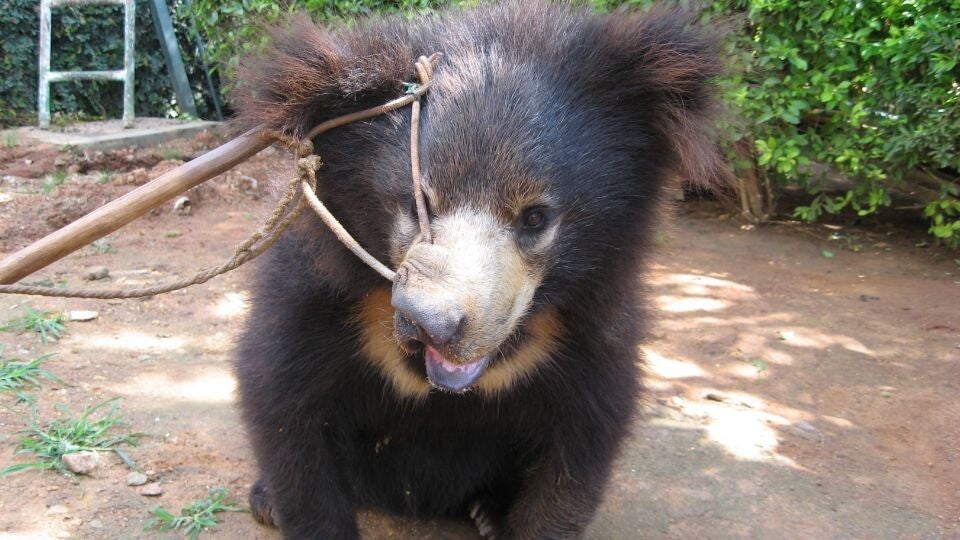
The Tragic History of Dancing Bears
For centuries, sloth bears were captured and forced to become “dancing bears” in India. Captured cubs were trained to perform tricks, often stepping on hot surfaces or being prodded and tortured into submission.
-
When cubs were captured (often from their mothers in the wild), they were physically restrained using metal nose rings.
-
A ring would be pierced through the septum of the bear’s nose. A rope or chain would be attached to this ring, acting as a leash.
-
Handlers could then control the bear’s movements by pulling or tugging on the rope, forcing the bear to “dance” or perform tricks.
The bear didn’t move voluntarily. Every step, sway, or “dance” was under coercion. To make them comply, some handlers used:
-
Hot surfaces (barefoot on burning coals or heated metal plates)
-
Whips or pokes
-
Food deprivation or other forms of manipulation
This method caused physical injuries (pierced noses, infected wounds, deformities), psychological trauma, and sometimes death. Bears often suffered lifelong scars even after being rescued.
This cruel practice caused immense suffering, and many bears died prematurely from injuries, malnutrition, or psychological trauma.
Thanks to activism and legal bans (like India’s Wildlife Protection Act, 1972), the practice has been largely eradicated, but the scars of this mistreatment remain, many former dancing bears struggle to survive in the wild or in rescue centers.
However, the horrors of the dancing bear trade didn’t just end with legal bans. Bears rescued from captivity often face behavioral problems such as fear, mistrust of humans, and difficulties interacting with other bears, physical ailments like chronic infections, broken teeth, or joint problems caused by years of unnatural performance and restraint and reproductive challenges since trauma and social disruption can affect cub survival and mating success.
Even wild populations sometimes show altered behaviors because human presence and previous capture pressures have forced them into suboptimal habitats, limiting their movements, and increased stress levels.
Survivors of Trauma and Threats
While many sloth bears were captured for the dancing bear trade, wild populations continue to face serious challenges. Those that remain in forests, grasslands, and scrublands across India, Sri Lanka, Nepal, and Bhutan are increasingly isolated due to habitat loss and fragmentation. Roads, agriculture, and urban expansion cut through their home ranges, making movement, mating, and foraging more difficult. The effects of past exploitation also ripple into the wild.
Despite these challenges, sloth bears are adaptable and resilient. They forage primarily on insects, fruits, and honey, climb trees to escape danger, and play a critical role in their ecosystems by dispersing seeds and controlling insect populations. Protecting wild sloth bears requires habitat conservation, conflict mitigation, and ongoing vigilance against poaching.

Conservation Status and Threats
Sloth bears remain Vulnerable on the IUCN Red List, with fewer than 20,000 mature individuals estimated in the wild. The main threats include:
-
Habitat loss and fragmentation: Forest clearance for agriculture, logging, and urban development cuts through home ranges.
-
Human-wildlife conflict: Bears entering villages or raiding crops are sometimes killed in retaliation.
-
Poaching and illegal trade: Though dancing bears are illegal, some bears are still taken for body parts or entertainment in rural areas.
-
Genetic isolation: Fragmented populations make inbreeding more likely, weakening resilience.
How You Can Help Sloth Bears
Your support can make a real difference:
Support rescue and rehabilitation centers
Organizations like Wildlife SOS care for former dancing bears and injured individuals, providing safe enclosures, medical care, and enrichment.
Promote habitat protection
Advocate for forest conservation, wildlife corridors, and sustainable land use that allows bears to forage and migrate naturally.
Reduce human-wildlife conflict
Support programs that provide compensation for crop damage, educate communities, and implement bear-proof storage for honey and food.
Raise awareness
Educate others about sloth bears, their ecological importance, and the cruelty they have endured, so the species can gain the recognition it deserves.
Sources
IUCN Red List. (2023). Melursus ursinus — Sloth Bear. Retrieved from https://www.iucnredlist.org/species/13143/116518798
Wildlife SOS. (2023). Sloth Bear Rescue & Conservation Programs. Retrieved from https://wildlifesos.org/wildlife/sloth-bear/
Singh, H. S., & Acharya, R. (2014). Ecology and Conservation of the Sloth Bear in India. Wildlife Conservation Journal, 8(2), 45–59.
Wildlife Protection Society of India. Dancing Bear Program. Retrieved from https://www.wpsi-india.org/dancing-bear-program.html
Nowell, K. & Jackson, P. (1996). Wild Cats: Status Survey and Conservation Action Plan. IUCN.